
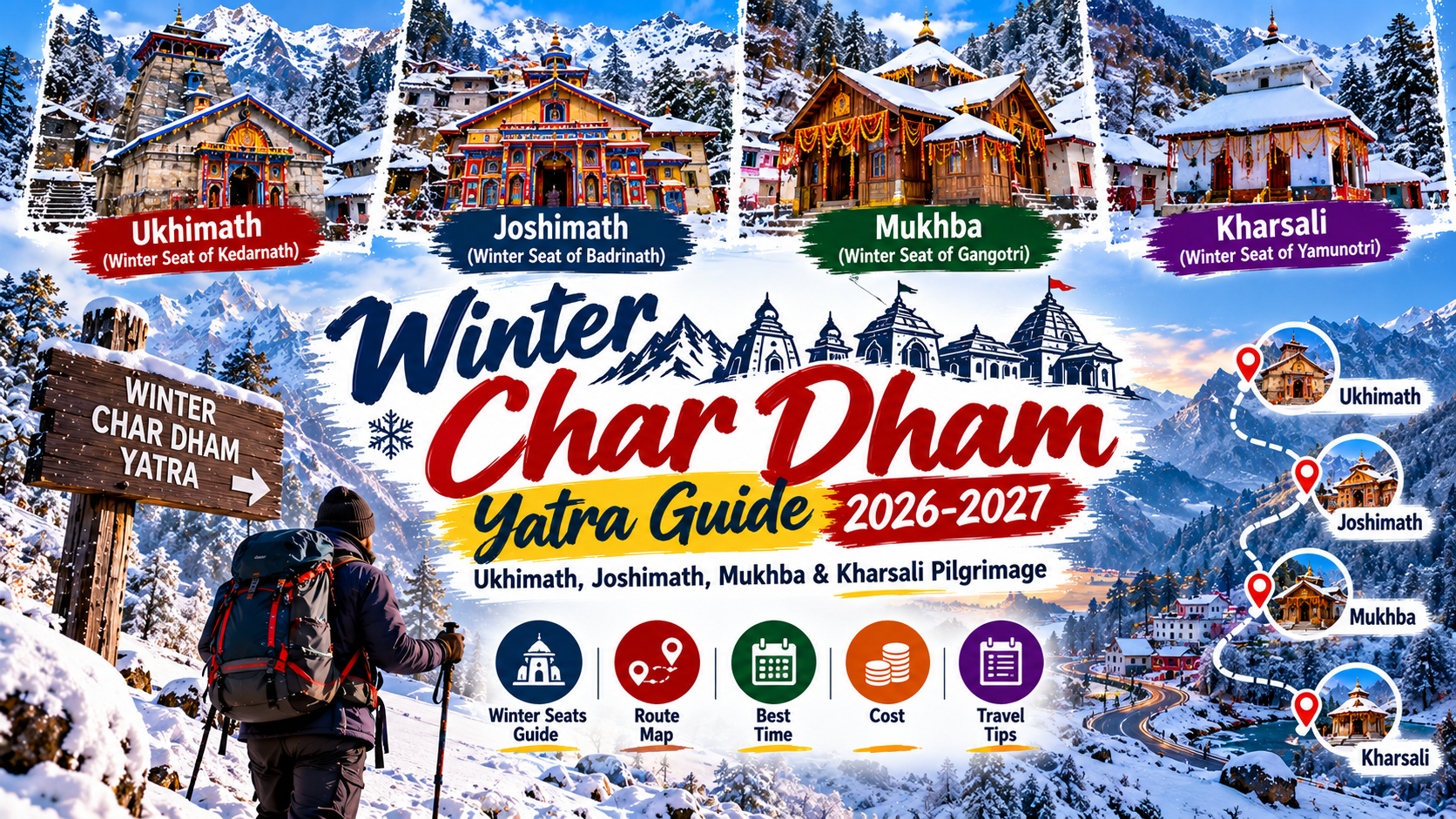
Every year as late autumn sets in across the high Garhwal Himalayas, temperatures plunge below freezing and heavy snowfall blankets the sacred shrines of Kedarnath, Badrinath, Gangotri, and Yamunotri. By late October and early November (traditionally around Diwali and Bhai Dooj), the high-altitude portals of the main Char Dham temples are ritually closed for six months. However, the divine worship never stops. In a time-honored spiritual tradition spanning millennia, the sacred idols (Utsav Murlis / Dolis) of the deities are ceremoniously carried down in grand musical processions to their accessible, lower-altitude winter seats.
This sacred winter circuit is known as the Winter Char Dham Yatra. Unlike the summer pilgrimage which often encounters sweltering heat, monsoon roadblocks, and overwhelming crowds of millions, the Winter Char Dham pilgrimage offers an intimate, tranquil, and deeply spiritual experience amidst pristine snowscapes. Whether you are a devotee seeking unhurried darshan or a traveler yearning to experience ancient Himalayan traditions in quiet reverence, this comprehensive 2026-2027 guide covers the four holy winter abodes, doli transit dates, route maps, day-by-day itineraries, and essential winter travel tips.
Winter Char Dham Yatra: Quick Overview
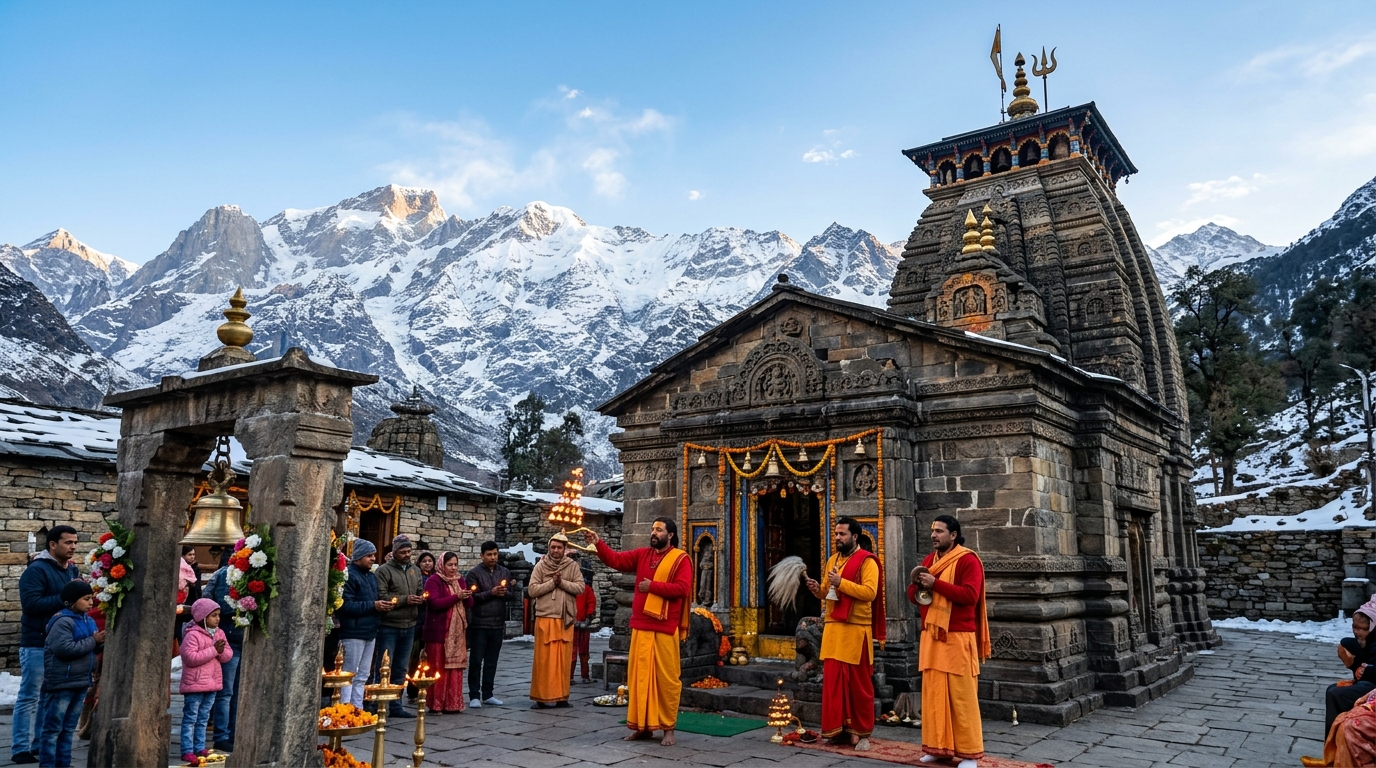
Ancient stone Omkareshwar Temple in Ukhimath (4,300 ft) — The sacred winter home of Lord Kedarnath and Madhyamaheshwar.
The 4 Sacred Winter Abodes of Uttarakhand
1. Omkareshwar Temple, Ukhimath (Winter Abode of Lord Kedarnath)
Perched on the mountain ridge across the Mandakini river from Guptkashi in Rudraprayag district, Ukhimath (4,300 ft / 1,311 m) serves as the winter seat of Lord Kedarnath as well as the fourth Kedar, Madhyamaheshwar. Following the ceremonial closing of the Kedarnath sanctum on Bhai Dooj, the Panchmukhi (five-faced) gold idol of Lord Shiva travels down in an ornate palanquin carried on the shoulders of bare-footed devotees amidst the beating of traditional drums and conch shells.
The ancient stone temple complex of Omkareshwar features intricate wood and stone carvings. Here, the holy Rawal (head priest from Karnataka's Veerashaiva tradition) and local priests perform daily morning and evening rudrabhishekam just as they do in high Kedarnath. According to legend, Ukhimath was also where the wedding of Usha (daughter of Banasura) and Aniruddha (grandson of Lord Krishna) took place, lending the town its historical name Ushamath.
2. Narasimha Temple & Pandukeshwar, Joshimath (Winter Abode of Lord Badrinath)
When the portals of Badrinath Dham close in mid-November, the sacred representative idol of Lord Vishnu (Uddhava Ji) and Kuber Ji travel down to Yog Dhyan Badri at Pandukeshwar, while the chief winter seat and representative pujas are conducted at the historic Narasimha Temple in Joshimath (6,150 ft / 1,875 m).
The Narasimha Temple dates back to the 8th century and is deeply intertwined with Adi Shankaracharya, who established his northern Jyotirmath monastery here under the sacred Kalpavriksha tree. The idol of Lord Narasimha (the half-man, half-lion avatar of Vishnu) is carved from black Shaligram stone. Local belief holds that one wrist of the Narasimha idol is thinning year by year; when it detaches, the road to high Badrinath will permanently close and the new shrine of Bhavishya Badri will manifest.
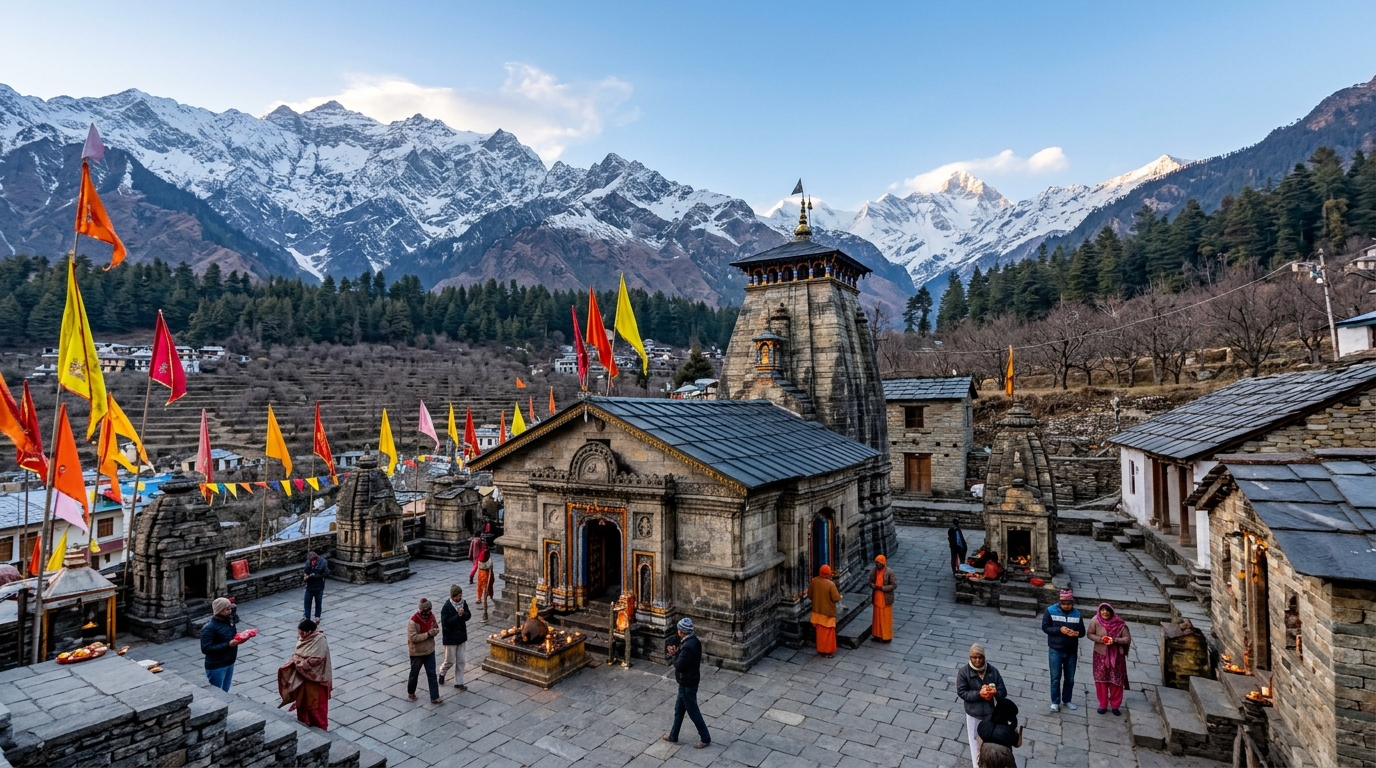
Narasimha Temple in Joshimath framed by towering snow-capped peaks — The winter epicenter of Badrinath worship.
3. Mukhba Village, Harsil Valley (Winter Abode of Goddess Ganga)
Located near the idyllic alpine hamlet of Harsil along the turquoise Bhagirathi River in Uttarkashi district, Mukhba (8,600 ft / 2,620 m) is a fairy-tale Himalayan village. On the auspicious day of Diwali or Bhai Dooj, the temple doors of Gangotri Dham are shut, and the silver murti of Mata Ganga is transported in a vibrant palanquin escorted by the Garhwal Rifles army band and the Semwal Brahmin priests to Mukhba.
The traditional two-story wooden temple at Mukhba features hand-carved cedar facades with ornate verandas. In winter, as snow coats the pine boughs and apple orchards of Harsil, the holy Ganga is worshipped here in intimate serenity. The priest offers sacred Gangajal straight from the winter riverbank, creating an ethereal spiritual encounter.
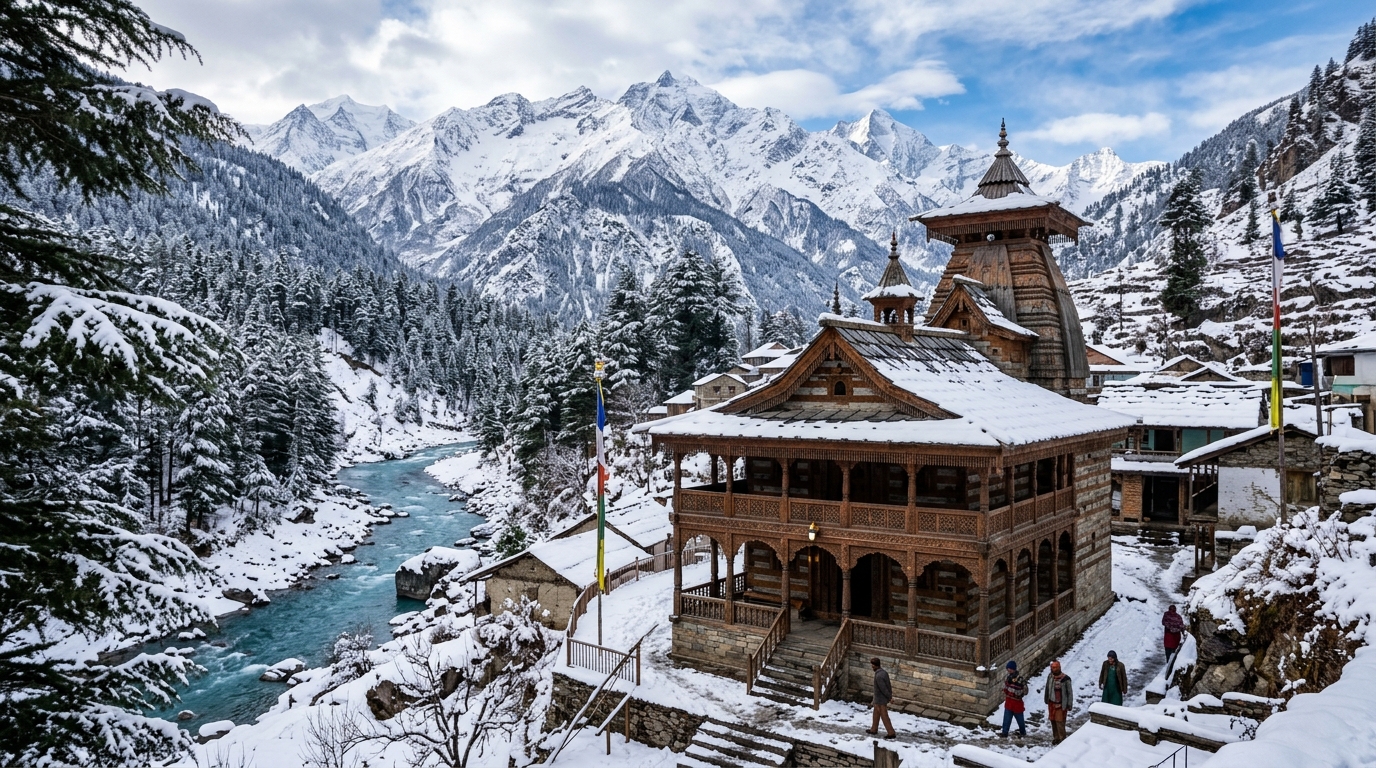
Carved cedar-wood architecture of Mukhba village temple surrounded by snow-covered pines along the Bhagirathi river.
4. Shani Dev Temple, Kharsali (Winter Abode of Goddess Yamuna)
Nestled just 1 km from Janki Chatti at the base of the Yamunotri mountain range, Kharsali (7,200 ft / 2,195 m) is an ancient stone and wood village that houses the holy winter seat of Goddess Yamuna. On Bhai Dooj, the idol of Yamuna is accompanied by her divine brother, Lord Shani, down from the frozen Yamunotri shrine to Kharsali.
Kharsali is celebrated for its imposing, four-story pagoda-style Shani Dev Temple built entirely of interlocking timber beams and mortarless stone without cement—an earthquake-resilient architectural marvel that has stood for over a thousand years. An eternal bronze lamp (Akhand Jyoti) burns inside the sanctum. Devotees receive personal blessings and prasadam directly from the hereditary Uniyal Brahmin priests.
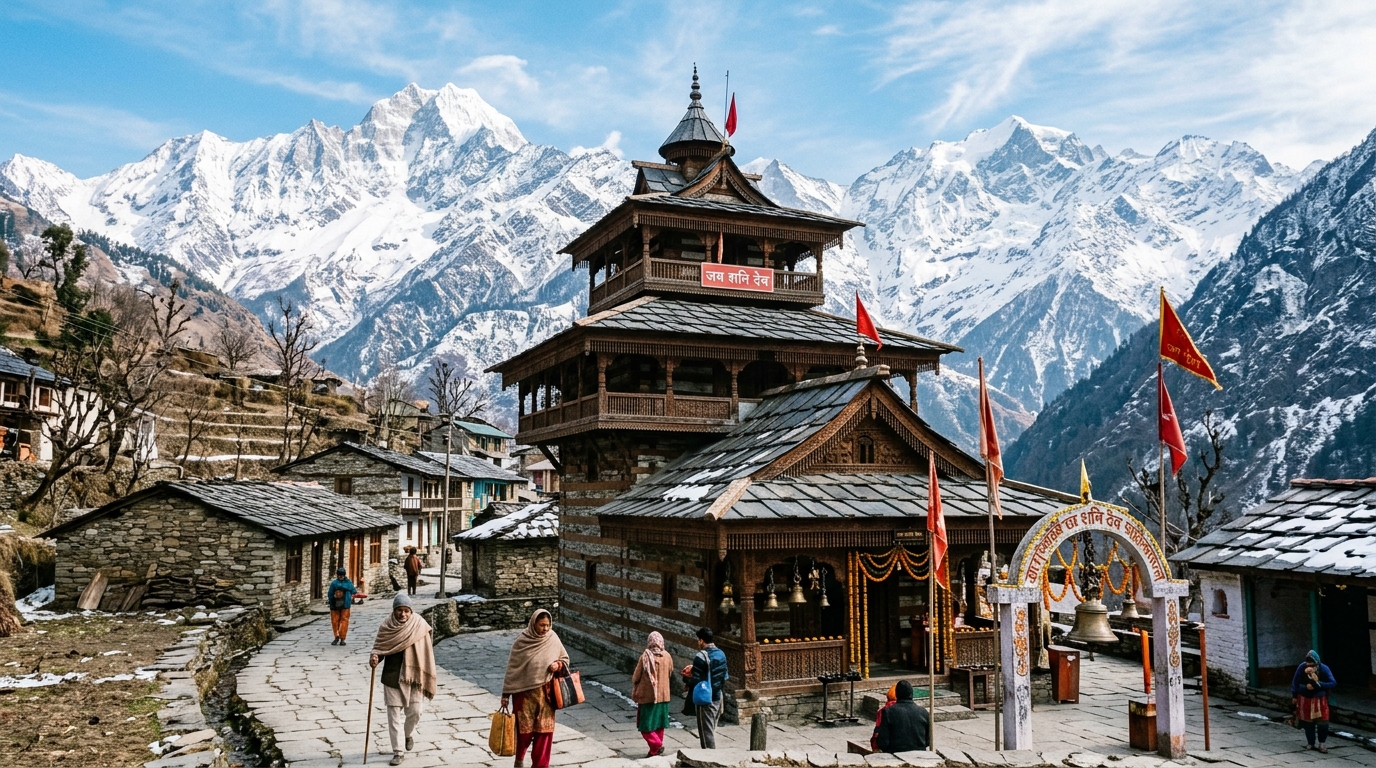
The ancient multi-story timber-and-stone Shani Dev Temple at Kharsali (7,200 ft) where Goddess Yamuna resides during winter.
Why Pilgrims Prefer the Winter Char Dham Circuit
Winter Char Dham Yatra: Detailed 7-Day Daywise Itinerary
Day 1: Haridwar / Dehradun to Barkot / Kharsali (Drive: 215 km | 7-8 Hours)
Depart early morning from Haridwar or Dehradun. The drive winds through Mussoorie, Kempty Falls, Nainbagh, and Damta along the Yamuna river valley. Reach Barkot or continue up to Janki Chatti / Kharsali by late afternoon. Check in to your hotel or traditional village resort. Enjoy evening hot ginger tea and rest.
Day 2: Kharsali (Yamunotri Winter Seat) Darshan & Transfer to Uttarkashi (Drive: 135 km | 5 Hours)
After morning breakfast, visit the magnificent ancient Shani Dev Temple in Kharsali. Offer prayers to the holy silver idol of Goddess Yamuna and admire the millennial pagoda architecture. Perform special pujas with the temple priests. Afterward, descend through Dharasu Bend to Uttarkashi (3,800 ft) along the Bhagirathi river. In the evening, attend the divine aarti at the ancient Kashi Vishwanath Temple in Uttarkashi. Overnight stay in Uttarkashi.
Day 3: Uttarkashi to Harsil & Mukhba (Gangotri Winter Seat) Darshan (Drive: 80 km | 3-4 Hours)
Drive through the scenic pine and deodar forests of Bhatwari and Gangnani (famous for natural hot sulfur water springs). Ascend into the alpine wonderland of Harsil Valley. Take a short, gentle 10-minute walk across the wooden footbridge over the crystal Bhagirathi river to Mukhba village. Seek the blessings of Mata Ganga in her ornate wooden winter abode. Savor authentic Garhwali lunch and organic apples. Overnight stay in a cozy wood-paneled resort in Harsil or Uttarkashi.
Day 4: Uttarkashi / Harsil to Guptkashi / Ukhimath (Drive: 200 km | 7 Hours)
Drive via Chamba or New Tehri with breathtaking views of the massive Tehri Lake reservoir. Descend to the Mandakini river valley and reach Guptkashi or Ukhimath by late afternoon. Enjoy magnificent views of the snow-clad Chaukhamba massif directly from your hotel balcony. Overnight stay in Ukhimath.
Day 5: Ukhimath (Kedarnath Winter Seat) Darshan & Chopta Excursion (Sightseeing: 60 km)
Early morning visit to the historic Omkareshwar Temple at Ukhimath. Attend the sacred Rudrabhishekam of Lord Kedarnath and Lord Madhyamaheshwar. Take your time circumambulating the stone temple courtyard. In the afternoon, take a scenic drive up to the snow-covered alpine meadows of Chopta (the Mini Switzerland of Uttarakhand) for snow views. Return to Ukhimath for overnight stay.
Day 6: Ukhimath to Joshimath (Badrinath Winter Seat) via Chamoli (Drive: 130 km | 5 Hours)
Follow the Alaknanda river valley passing through Gopeshwar and Pipalkoti to reach Joshimath (6,150 ft). Visit the ancient Narasimha Temple complex and the holy Adi Shankaracharya Math with the 2,500-year-old Mulberry tree. Optional excursion: Take the ropeway cable car up to the snowy slopes of Auli for sunset over Nanda Devi. Overnight stay in Joshimath.
Day 7: Joshimath to Haridwar / Rishikesh via Panch Prayag (Drive: 275 km | 8-9 Hours)
Begin your return journey following the sacred Alaknanda and Ganga rivers. En route, witness the holy river confluences of Nandprayag, Karnaprayag, Rudraprayag, and Devprayag (where the Alaknanda and Bhagirathi merge to form the holy River Ganga). Reach Rishikesh or Haridwar Railway Station by evening, completing your transformative Winter Char Dham Yatra.
Estimated Winter Char Dham Yatra Budget (2026-2027)
Essential Packing List for Winter Char Dham
Frequently Asked Questions (FAQ)
Is it possible to visit the main Kedarnath & Badrinath temples in winter?
No. The main temples of Kedarnath and Badrinath are completely snowbound from November to April, and their sanctum doors are physically sealed. All rituals and darshans take place exclusively at their winter abodes in Ukhimath and Joshimath.
Are the roads safe and open during the Winter Char Dham Yatra?
Yes. The state highways connecting Haridwar, Rishikesh, Uttarkashi, Harsil, Ukhimath, and Joshimath remain open throughout winter. The Border Roads Organisation (BRO) and PWD actively clear roads after snow events. Roads to the winter shrines are wide, well-maintained, and avoid dangerous high mountain passes.
Is registration mandatory for Winter Char Dham Yatra?
No cumbersome e-pass tokens or daily visitor quotas are required for Winter Char Dham! Unlike the summer yatra which has strict daily registration caps, winter pilgrims can travel with freedom and flexibility.

Ready to Experience the Sacred Winter Char Dham Yatra? Connect with Tourscave Pilgrimage Specialists
Call / WhatsApp: +91 7351721624 • Email: info@tourscave.com