
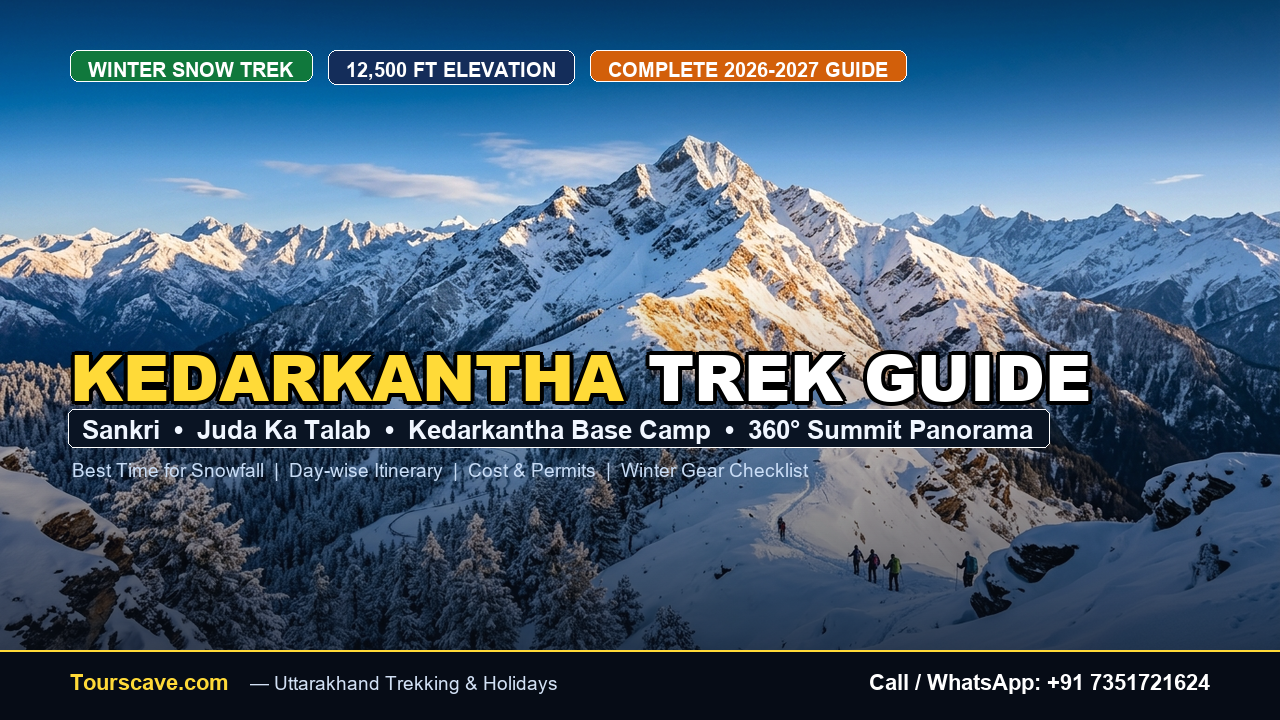
If there is one trek that defines the quintessential Himalayan winter wonderland for Indian and international adventurers, it is undeniably the Kedarkantha Trek. Perched at a majestic altitude of 12,500 feet (3,810 meters) inside the Govind Wildlife Sanctuary in Uttarkashi district, Uttarakhand, this classic trail offers an unmatched winter experience: walking through silent, snow-laden oak glades, pitching colorful tents beside the frozen alpine tarn of Juda Ka Talab, and standing atop a wind-swept rocky crest at dawn to witness a 360-degree amphitheater of snow-capped giants.
Whether you are taking your very first step into high-altitude winter trekking or returning to the Garhwal Himalayas for an unforgettable snow adventure, this comprehensive 2026–2027 Kedarkantha Trek Guide covers every practical detail: route progression, month-wise snowfall timings, realistic costs, day-by-day itineraries, winter gear essentials, and forest permits.
1. Why Kedarkantha is India's Crown Jewel of Winter Snow Treks
Unlike many high Himalayan passes that remain strictly closed between December and March due to impassable avalanche-prone terrain, Kedarkantha is uniquely gifted with a gentle, progressive gradient. Its pyramid-shaped summit rises gracefully above the tree line, offering accessible alpine adventure throughout the peak winter months.
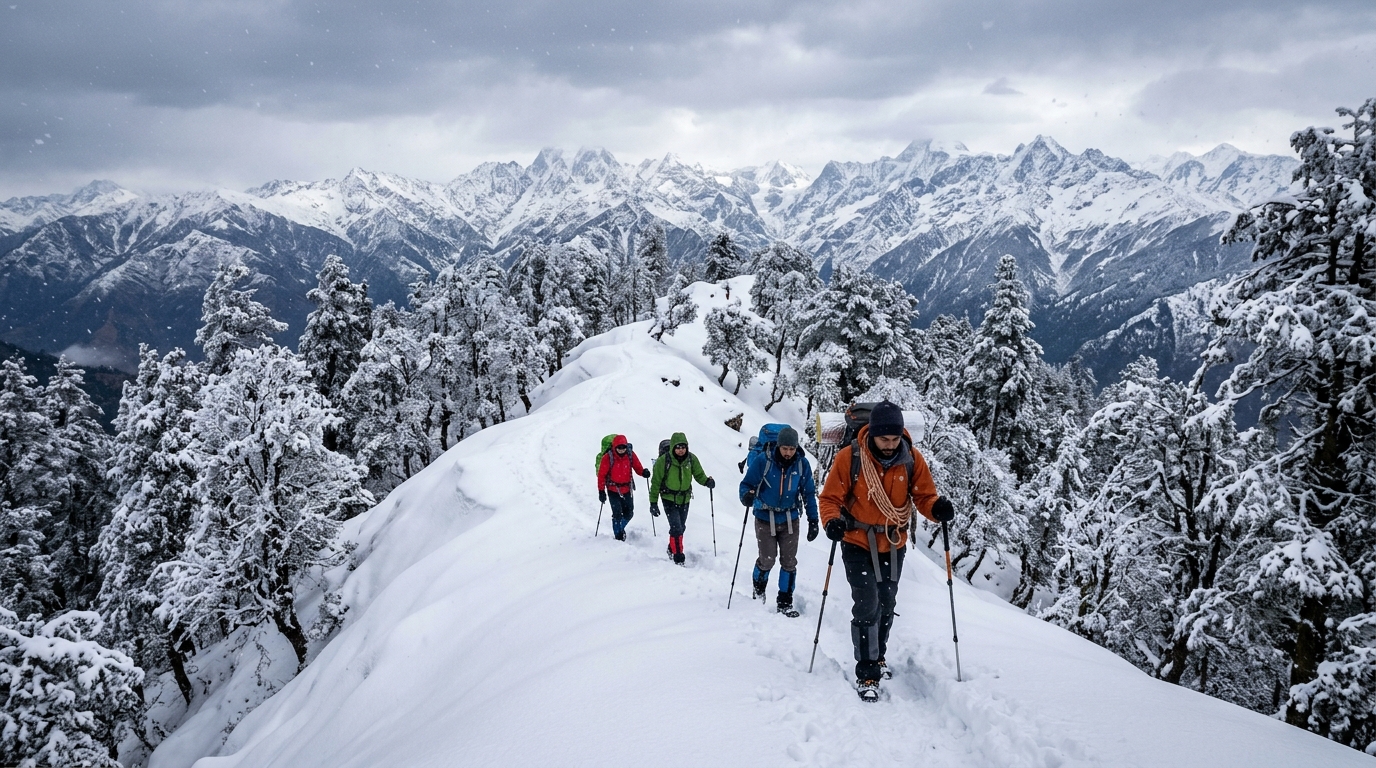
Trekkers traversing the snow-covered ridge trail amidst towering pine and silver oak glades.
What sets Kedarkantha apart from other beginner treks like Chopta Tungnath Chandrashila is the exceptional beauty of its campsites. You do not return to guesthouses after day hikes; instead, you sleep under the stars in snow-covered meadows, watch the milky way shimmer above icy ridgelines, and ascend to the summit right in time to greet the sunrise over the higher Himalayas.
- Maximum Altitude: 12,500 ft (3,810 m)
- Trek Distance: ~20 km (Round trip from Sankri)
- Duration: 5 Days / 4 Nights (Dehradun to Dehradun)
- Difficulty Level: Easy to Moderate (Beginner-friendly with basic cardiovascular fitness)
- Trail Basecamp: Sankri Village (6,400 ft)
- Highlights: Frozen Juda Ka Talab, Kedarkantha Basecamp, 360° summit views of Swargarohini, Bandarpoonch, Black Peak (Kalanag), and Dhaula Dhar ranges.
2. Sankri Basecamp: The Ancient Wooden Gateway
Your journey begins at Sankri, a scenic hamlet tucked deep inside the Govind Ballabh Pant National Park. Situated approximately 210 km from Dehradun, Sankri retains its timeless charm with multi-tiered traditional Garhwali wooden houses, carved slate balconies, and fragrant pine hillsides.
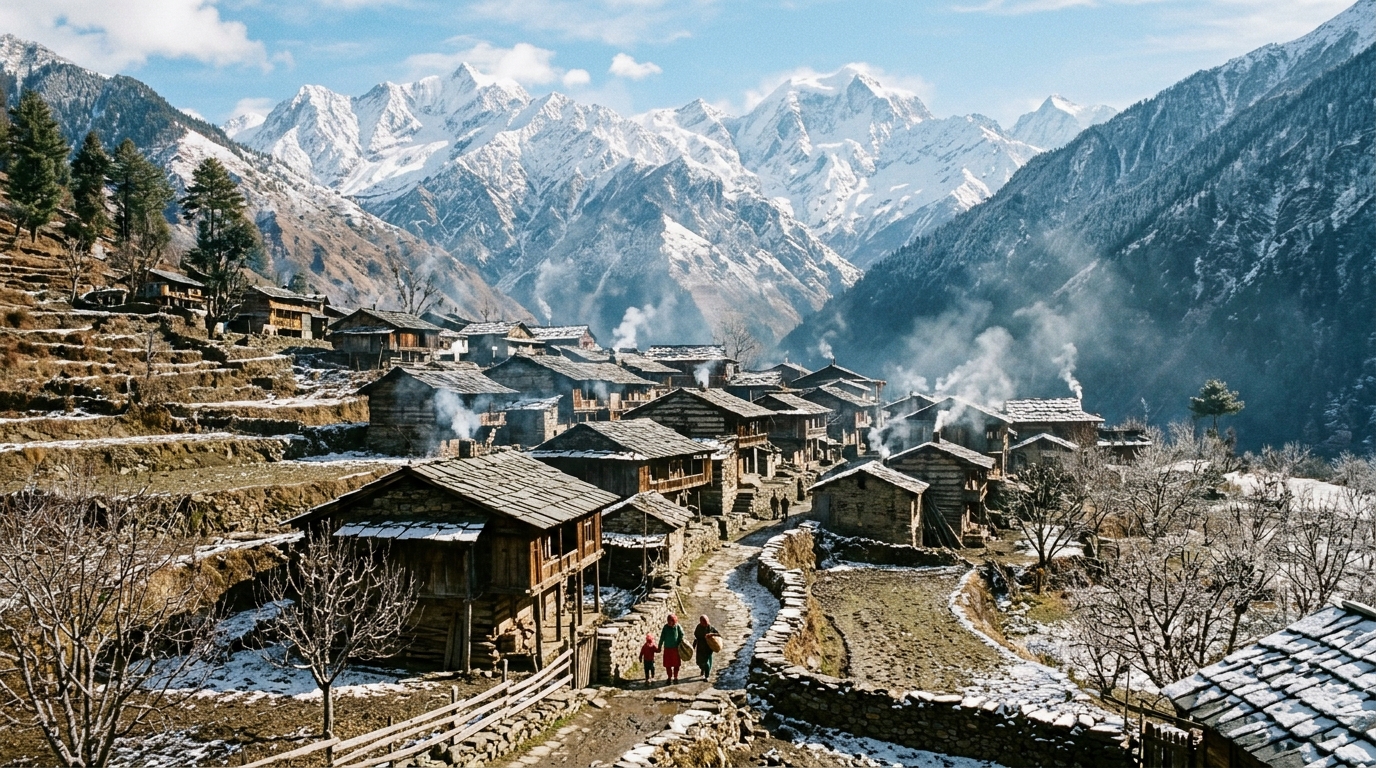
Sankri basecamp: traditional Garhwali architecture with dramatic Himalayan backdrop.
Sankri serves as the common starting point for several legendary expeditions, including Har Ki Dun, Bali Pass, and Rupin Pass. The village has cozy local homestays, winter gear rental shops (microspikes, gaiters, trekking poles, down jackets), and small cafes serving piping hot thukpa and Garhwali dal. Note: Mobile connectivity in Sankri is largely limited to BSNL and occasional Jio 4G signals; data networks beyond Sankri remain unavailable, allowing for a truly unplugged mountain retreat.
3. Juda Ka Talab: The Mystical Frozen Alpine Lake
After a 4-hour steady ascent from Sankri through dense forests of chestnuts, silver birch, and deodar trees, you arrive at Juda Ka Talab (9,100 ft). This picturesque high-altitude lake is steeped in local legends: folklore has it that Lord Shiva once meditated here, and a drop of water that uncoiled from his matted locks (Juda) created this sacred water body.
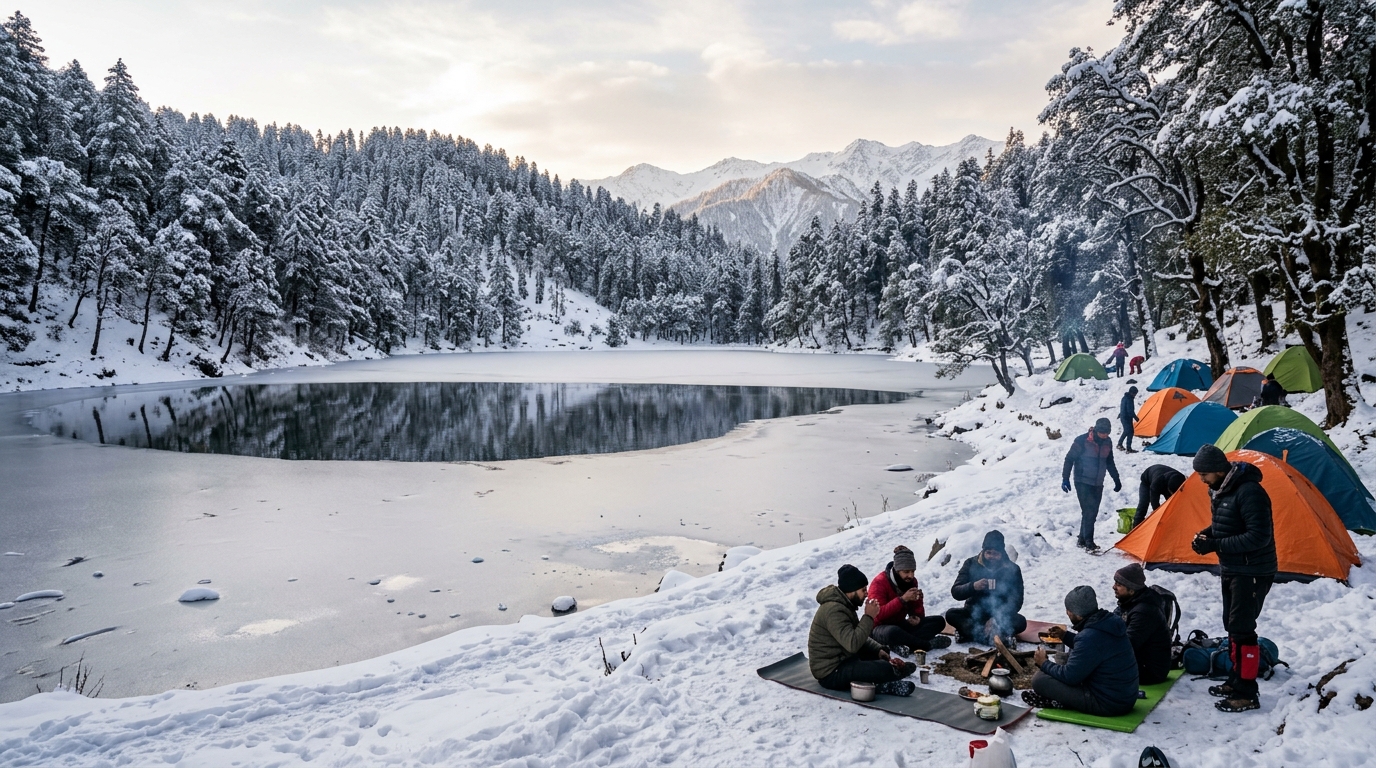
Juda Ka Talab frozen solid under winter frost with winter tents lined along the forest clearing.
Between late December and early February, Juda Ka Talab freezes into a solid sheet of translucent ice, reflecting the snow-draped pine canopies around its banks. Pitching tents on the snowy slopes overlooking the lake and sipping hot ginger tea while campfire embers crackle is an experience etched forever in every trekker's memory.
4. Kedarkantha Basecamp: Night Sky & Snowy Wilderness
Continuing above Juda Ka Talab, the tree line gradually thins out, unveiling sprawling snowy meadows (bugyals) that lead up to the Kedarkantha Base Camp (10,600 ft). Positioned on an open sub-alpine shelf, this camp offers an uninterrupted front-row amphitheater view of the triangular Kedarkantha peak towering directly ahead.
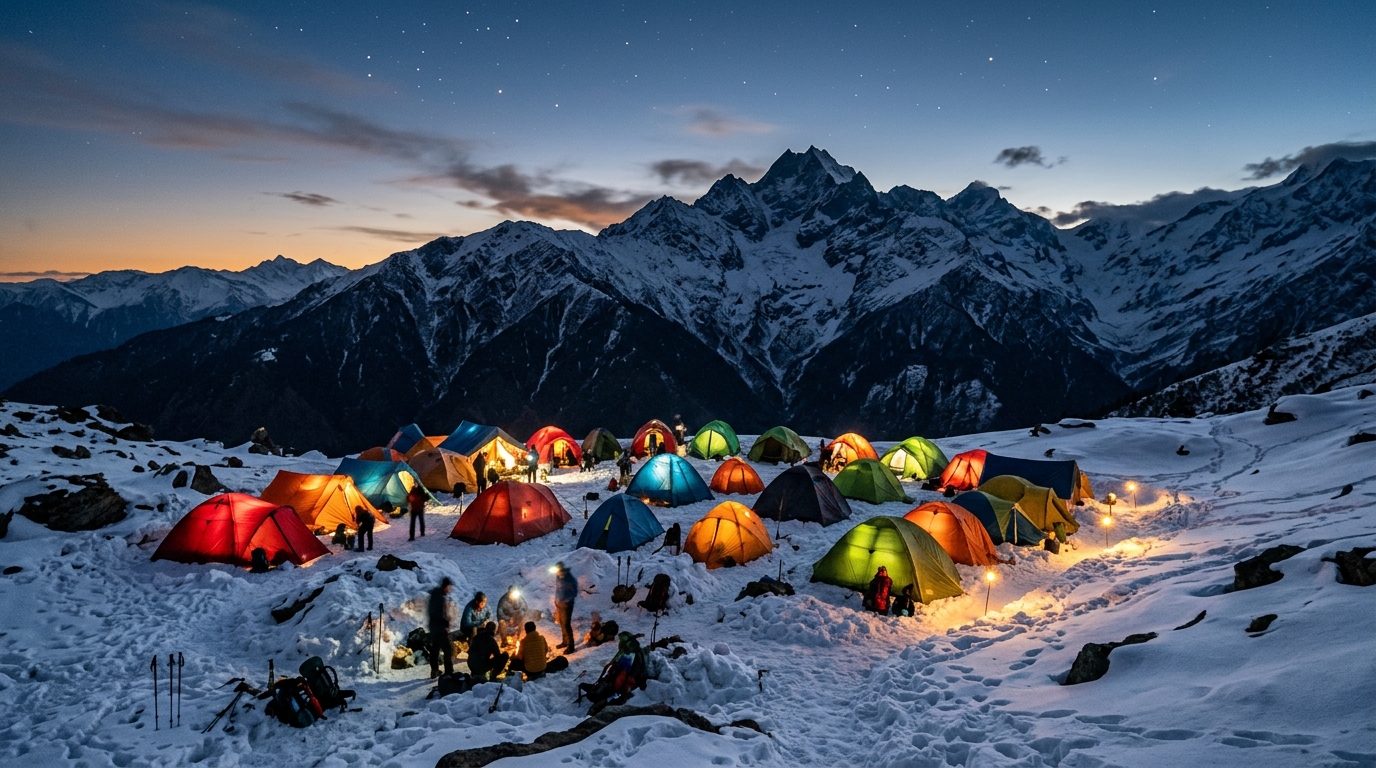
The magical twilight glow at Kedarkantha Base Camp as temperatures plunge below freezing.
Evenings at the base camp are crisp and quiet. Temperatures frequently hover between -5°C and -10°C in mid-winter. With zero light pollution, the night sky transforms into a dazzling cosmic display with billions of stars and shooting meteors. Trekkers retire early into thermal sleeping bags, because the final summit assault begins well before the break of dawn.
5. The Golden Summit Push (12,500 Ft) & 360° Himalayan Panorama
The summit day begins around 3:30 AM. Equipped with headlamps, microspikes strapped to trekking boots, and insulated gloves, trekkers climb the craggy eastern ridge in a steady single file. As you navigate the steep snow gullies beneath the summit dome, the darkness slowly yields to shades of violet, orange, and gold along the horizon.
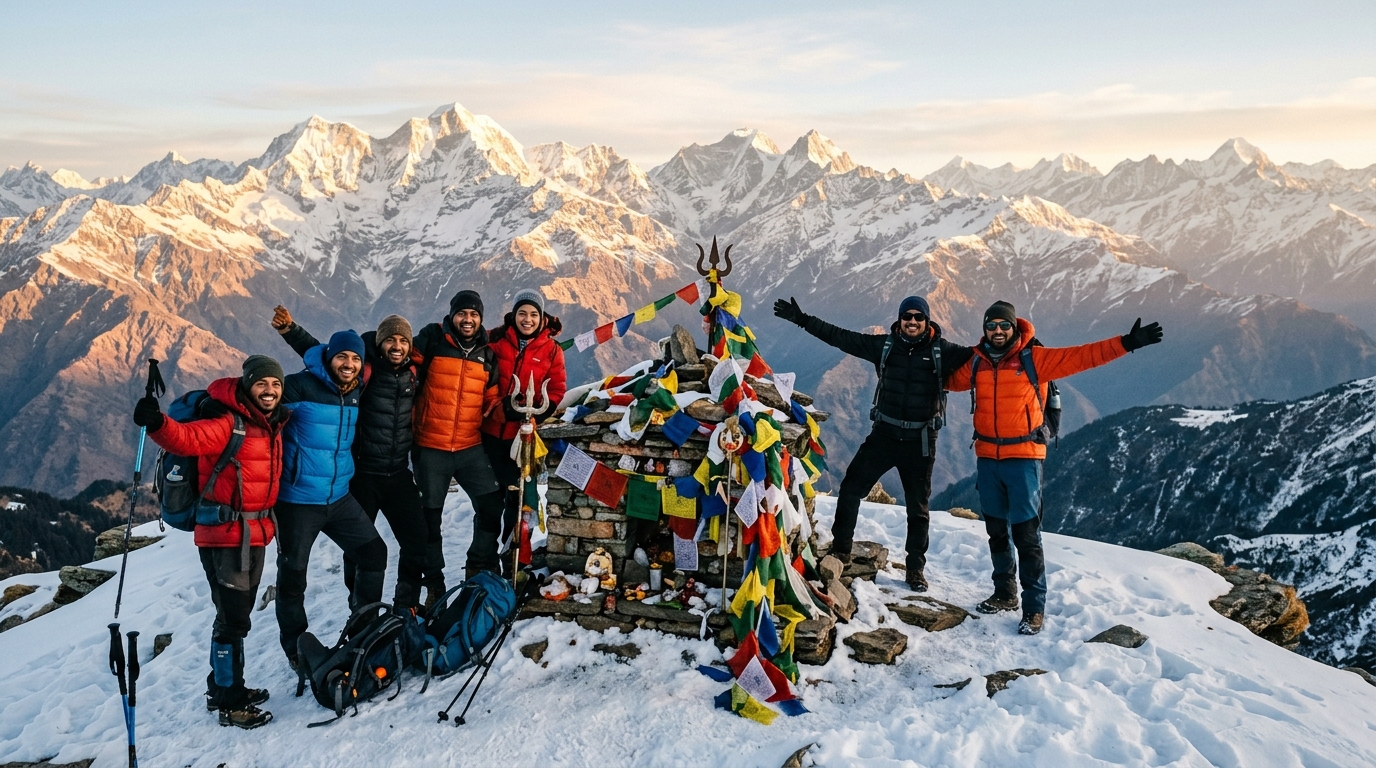
Joyous summiters at the stone Shiva shrine atop Kedarkantha (12,500 ft) during sunrise.
Reaching the summit (12,500 ft) right as the sun breaches the horizon is nothing short of transcendent. At the apex sits a modest stone altar dedicated to Lord Shiva, adorned with tridents (trishuls) and prayer flags fluttering in the mountain wind. Looking out, the panorama is simply breathtaking:
- Swargarohini Massif (I, II, III, IV): The mythical stairway to heaven.
- Bandarpoonch (Monkey's Tail) & White Peak: Glistening in pristine snow.
- Black Peak (Kalanag): The formidable 6,387 m summit dominating the northern skyline.
- Chaukhamba & Kinnaur Kailash: Visible on exceptionally clear mornings.
6. Day-Wise Kedarkantha Trek Itinerary (5 Days / 4 Nights)
Day 1: Dehradun to Sankri (Drive: 210 km | 8–9 hours)
Pick up from Dehradun Railway Station / ISBT early morning (6:30 AM). The scenic mountain road winds past Mussoorie, Nainbagh, Damta, Purola, and Mori along the crystal-clear Tons River before arriving at Sankri (6,400 ft). Overnight stay in a local guesthouse or homestay.
Day 2: Sankri to Juda Ka Talab (Trek: 4 km | 4–5 hours | Altitude: 9,100 ft)
After breakfast and briefing, the trek kicks off from Saur village. The trail ascends through pine groves and apple orchards, crossing small wooden bridges over babbling forest streams. Camp overnight in tents next to Juda Ka Talab.
Day 3: Juda Ka Talab to Kedarkantha Base Camp (Trek: 4 km | 3–4 hours | Altitude: 10,600 ft)
A gentle climb leads out of the tree line onto open snowy slopes with wide-angle views of Bandarpoonch and Swargarohini. Settle into the Kedarkantha Base Camp by lunchtime. Spend the afternoon resting, acclimatizing, and testing microspikes for the summit push.
Day 4: Base Camp to Kedarkantha Summit (12,500 ft) & Descend to Hargaon / Sankri (Trek: 9 km | 7–8 hours)
Summit day! Wake up at 3:00 AM for tea and light snacks. Ascend the snowy ridge to reach the summit for sunrise (6:30 AM). Celebrate, take photos, and descend back to Base Camp for hot lunch, followed by a gradual descent to Hargaon campsite or directly down to Sankri for celebration dinner.
Day 5: Sankri to Dehradun Departure (Drive: 210 km | 8–9 hours)
Board the return vehicle to Dehradun. Arrive at Dehradun Railway Station by 6:00 PM, connecting seamlessly with overnight trains and buses back to Delhi, Chandigarh, or onwards. You can also combine this with a day of relaxation and river rafting in Rishikesh.
7. Best Time for Snowfall & Month-by-Month Weather Guide
| Period / Months | Day / Night Temp | Snow Conditions | Trekking Experience |
|---|---|---|---|
| Dec to Jan (Peak Winter) | 5°C to -10°C | Heavy fresh snowfall; frozen lake | The ultimate snow trek; magical white landscape, high thrill. |
| Feb to March (Late Winter) | 8°C to -5°C | Stable hard-packed snow; clear skies | Excellent walking grip with microspikes; bright sunny days. |
| April to May (Spring) | 15°C to 2°C | Snow recedes; rhododendrons bloom | Vibrant red and pink forests, warm trekking weather. |
| Oct to Nov (Autumn) | 12°C to 0°C | No snow; crisp clear skies | Crisp golden hues, sharpest mountain visibility, fewer crowds. |
8. Trek Difficulty, Fitness Preparation & Essential Packing Checklist
Kedarkantha is classified as an Easy to Moderate trek. You do not require prior mountaineering experience, but walking 5–6 km daily on snow with a 7–8 kg backpack does require reasonable cardiovascular stamina.
3-Week Preparation Routine:
- Jog or brisk walk for 4 to 5 km in under 30 minutes, 4 times a week.
- Practice stair climbing (15–20 floors) with a weighted backpack to strengthen calves and glutes.
- Include core stretches, lunges, and deep squats to maintain balance on uneven icy slopes.
Winter Snow Packing Essentials:
- Clothing System: 2 thermal inner layers, 2 quick-dry trekking t-shirts, 1 warm fleece jacket, 1 heavy down/feather jacket (-10°C rated), and 2 waterproof trekking pants.
- Footwear: High-ankle waterproof trekking shoes with deep lugged soles (Quechua, Columbia, Woodland) + 4 pairs of woolen socks.
- Snow Accessories: Microspikes and waterproof gaiters (provided in Tourscave packages), UV-protected polarized sunglasses (essential to prevent snow blindness), fleece balaclava/beanie, and waterproof insulated gloves.
- Health & Hydration: 2 insulated thermos flasks (1 liter each), Diamox (for altitude acclimatization after medical consult), moisturizers, and high-SPF sunscreen.
9. Kedarkantha Trek Cost, Permits & Budget Breakdown (2026–2027)
A standard 5-day Kedarkantha package typically ranges between ₹6,500 to ₹10,500 per person depending on whether transport from Dehradun is included, tent sharing options, and seasonal demand during Christmas and New Year.
- Forest Permit & Camping Fee: ₹150–₹250 per person per day (Govind Wildlife Sanctuary Forest Department counter at Mori/Sankri).
- Certified Mountain Guide & Cook: ₹1,500 to ₹2,500 per day for a certified local team.
- Mule / Porter Support: ₹600 to ₹800 per day for offloading personal luggage (optional).
- Shared Taxi (Dehradun to Sankri): ₹800 to ₹1,000 per seat each way (Tempo Traveler / Bolero).
For more Himalayan itineraries, you can also explore our Valley of Flowers Trek Guide and advance planning for the sacred Char Dham Yatra 2027.
10. Frequently Asked Questions (FAQs)
Q1. Can a beginner do the Kedarkantha Trek?
Yes! Kedarkantha is one of India's best beginner-friendly winter snow treks. The daily walking distances are modest (4 to 5 km per day), and the ascent gradient is steady and gradual without technical climbing sections.
Q2. Which month has the best snow in Kedarkantha?
Late December, January, and February offer the thickest, most pristine snow cover. If you wish to witness fresh snowfall, the peak window is between December 20 and January 31.
Q3. What is the temperature at Kedarkantha during winter?
Daytime temperatures range from 5°C to 10°C when sunny. At night, temperatures drop sharply to -5°C to -10°C at Juda Ka Talab and Base Camp. High-grade four-season sleeping bags are essential.
Q4. Are microspikes and gaiters compulsory?
Yes, between December and March, snow turns into hard slippery ice along the upper ridges. Microspikes give your shoes solid grip, while gaiters prevent snow from entering inside your boots.
Q5. Is mobile network available during the trek?
BSNL and occasionally Jio have intermittent calling reception at Sankri. Beyond Sankri, there is virtually zero mobile connectivity, giving you total digital detox in the mountains.
Q6. Are washroom facilities available at the campsites?
Organized operators set up dedicated dry toilet tents at every campsite (Juda Ka Talab and Base Camp). Toilet paper and sawdust are provided in an eco-friendly manner to maintain sanitation in sub-zero temperatures.
Q7. How do I reach Sankri from Delhi or Dehradun?
Take an overnight train (Nanda Devi Express / Jan Shatabdi) or Volvo bus to Dehradun. From Dehradun Railway Station, early morning shared taxis and Uttarakhand State Transport buses depart for Sankri around 5:30 AM to 7:00 AM.
Q8. What if I feel Acute Mountain Sickness (AMS)?
Because the altitude gain is steady (6,400 ft to 12,500 ft over 3 days), severe AMS is rare. Drink 3–4 liters of water daily, ascend at an even pace, and inform your trek leader immediately if you feel persistent nausea or headache.
Q9. Can children or senior citizens undertake this trek?
Children aged 9+ with basic outdoor stamina and senior citizens up to 60 with sound health and prior walking practice can comfortably complete the trek with adequate acclimatization.
Q10. Can I rent winter gear at Sankri?
Yes, Sankri has multiple gear rental shops offering trekking poles (₹50/day), waterproof jackets/trousers (₹150–₹250/day), snow boots (₹200/day), and gaiters/microspikes.
11. Plan Your Winter Himalayan Adventure with Tourscave
Looking for a hassle-free, safe, and exhilarating winter trek to Kedarkantha? Tourscave brings you end-to-end trekking arrangements, including sanitized transport from Dehradun, certified local Garhwali guides, high-altitude alpine camping gear, delicious hot nutritious meals, and all forest department permits.
Ready for the 2026–2027 Winter Snow Wonder?
Book your Kedarkantha fixed departures or get a custom group quote with dedicated trek leaders.
Phone / Direct Call: +91 7351721624
WhatsApp: Chat on WhatsApp (+91 7351721624)
Email: info@tourscave.com | Website: Tourscave.com